

You’ve typed “hey” and deleted it four times. You’ve stared at your phone for ten minutes trying to figure out the perfect opening text. You’ve drafted a reply, put your phone down, picked it back up, rewritten it, and then just… not sent it at all.
If this sounds like your texting life, you’re not alone. Text anxiety is incredibly common — and the irony is that texting was supposed to make communication easier. No face-to-face pressure, no awkward silences, plenty of time to think. Yet for a lot of people, it’s become its own unique torture chamber.
I coach people on communication for a living, and I can tell you: the anxiety you feel about texting isn’t really about texting. It’s about the same things that make all social situations hard — fear of judgment, uncertainty about how you’re coming across, and the lack of feedback that makes your imagination run wild.
Why texting is actually harder than talking in person
This might sound backwards, but hear me out. In a face-to-face conversation, you have a massive amount of information to work with: tone of voice, facial expressions, body language, the pace of the conversation. Your brain processes all of these signals in real time and adjusts automatically. You know if someone is interested, bored, amused, or confused because you can see it.
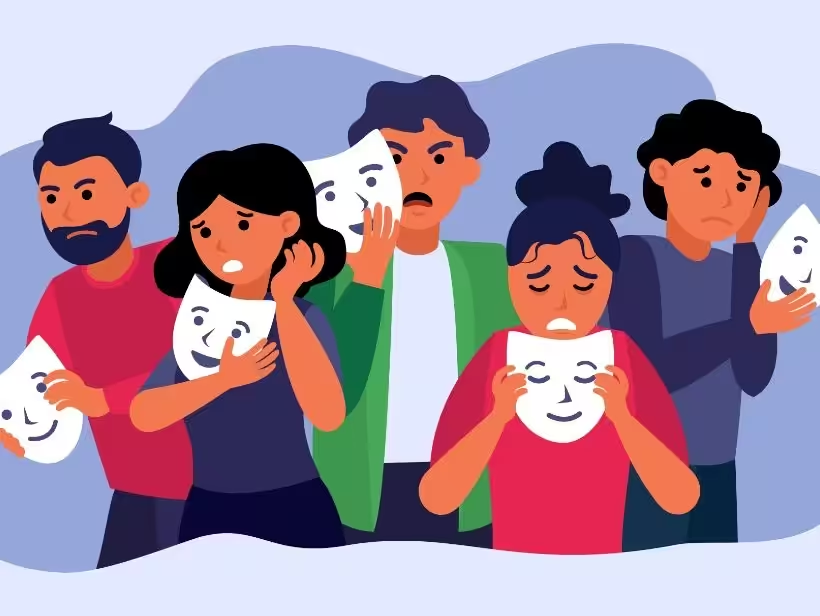
Texting strips all of that away. You’re left with just words on a screen — and your brain, which evolved to read faces and voices, has to fill in the gaps. So it does what anxious brains do best: it fills them in with worst-case scenarios. “They didn’t reply for two hours — they must be annoyed.” “They just said ‘ok’ — are they mad?” “They used a period at the end of the sentence — is that passive aggressive?”
None of these interpretations are necessarily true. But without the nonverbal cues you’d get in person, your anxiety treats them as fact.
The overthinking spiral
Here’s the pattern I see with almost every student who struggles with text anxiety:
You want to send a message. You start composing it. Then your inner editor shows up: “That sounds too eager.” Delete. “That sounds too casual.” Delete. “What if they don’t respond?” Stare at blank screen. “What if they think I’m weird?” Put phone down. “But if I don’t text, they’ll think I don’t care.” Pick phone up. Repeat for twenty minutes. Send something mediocre or send nothing at all.
The problem isn’t that you’re bad at texting. The problem is that you’re trying to control how someone else perceives you through a medium that gives you zero feedback. That’s a recipe for paralysis.
How to actually get past it
Send the first draft. I mean it. Whatever you typed first — before the editing, the second-guessing, the deleting — that was probably fine. Maybe even good. The overthinking rarely improves the message; it just delays it and adds anxiety. Practice sending your first instinct and watching the world not end.
Set a “compose time” limit. Give yourself 30 seconds to write a text and hit send. If it takes you longer than that for a casual message, you’re overthinking. This isn’t about being careless — it’s about training yourself to trust that imperfect communication is better than no communication.
Stop reading into response times. This is the big one. Someone not texting back for a few hours almost never means what your anxiety tells you it means. People are at work. Their phone is in another room. They saw it, meant to reply, and got distracted. You do the same thing to other people. Remind yourself of that.
Use voice notes or calls when the stakes feel high. If a text conversation is giving you serious anxiety — especially something emotional or important — switch to a voice note or phone call. You get your tone back, which eliminates most of the misinterpretation risk. It also feels more human, which is ultimately what connection is about.
Start conversations with observations, not questions. One reason people freeze when initiating a text is the pressure of picking the “right” opener. Here’s a trick: instead of asking a question (which puts pressure on both of you), share an observation or a thought. “Just walked past that coffee place you mentioned — looked packed” is way more natural than “Hey, how’s your day going?” It gives the other person something specific to respond to.
The deeper issue: text anxiety is social anxiety in disguise
Here’s what I’ve noticed across hundreds of students: people who have text anxiety almost always have some version of social anxiety more broadly. The texting is just one expression of a bigger pattern — a pattern of worrying about how you’re perceived, second-guessing yourself in social situations, and avoiding connection because it feels risky.
Lauren, one of our alumni, described her transformation this way: “Now I feel comfortable talking to anyone and can build rapport and connection really fast.” That shift didn’t just happen in person — it changed how she texted, how she showed up online, how she approached all communication. Because confidence isn’t channel-specific. When you feel good about yourself socially, that confidence shows up everywhere.
Jonathan, another student, said: “When going out, I’ve talked to strangers I would usually shell up around. At a bonfire, I was able to start the conversation and keep it going among a group of people I only knew the host.” When you can do that — talk to actual strangers in real life — sending a text to someone you already know becomes laughably easy by comparison.
Build the skill, lose the anxiety
Text anxiety fades when your overall social confidence rises. It’s that simple. When you trust your ability to connect with people — in any medium, in any situation — the anxiety around one specific channel (texting) naturally dissolves.
That’s what we work on at Jaunty. Our live classes aren’t about texting specifically — they’re about building the foundational confidence and communication skills that make everything easier. Conversation, flirting, meeting new people, deepening existing relationships, and yes, texting without spiraling.
The next time you’re staring at your phone, paralyzed by a three-word text, remember: the problem was never the text. It’s the confidence behind it. And confidence is buildable.